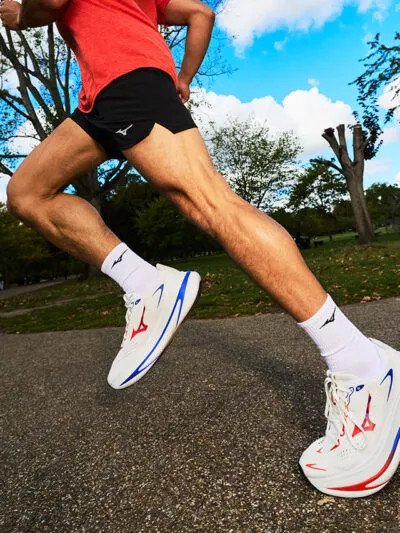
On and Nike can make any shoe look good. These two brands have some of the most versatile and modern-looking shoes on the market. But having spent time running with both brands, there are some pretty stark differences.
With its tenure in sports, Nike always feels a bit easier to read. You put on a Pegasus or a Vomero, and it’s kind of the same idea it’s been for generations, just with a few upgrades every release season.
On tends to lean harder into geometry, rocker shape, and that slightly engineered sensation the brand has become known for.
We wouldn’t say either approach is necessarily better on its own, but as a runner, it can change how you get along with a certain brand.
However, instead of turning this into a brand war, we’re going to look at how the shoes compete with one another based on competing models:
So, Nike running shoes or On running shoes? Stick around to find out.
Everyday Trainers – Nike Pegasus 42 vs. On Cloudsurfer 3
The On Cloudsurfer 3 and Nike Pegasus 42 are great options when you want an everyday trainer that you’ll rack up a lot of miles on. They’re similar shoes with a lower stack height and durable design, so they often draw comparisons.
Here are a few key qualities that differentiate each one to help with your decision-making process.
Nike Pegasus 42


We’ve heard some runners talking about how it’s time to put the Pegasus out to pasture. We don’t agree. It’s a staple in athletic footwear, and when it comes to daily miles, treadmill work, gym sessions, walking around, or just about anything else, it’s dependable.
It uses a ReactX midsole with a full-length Air Zoom unit, and the ride is familiar Nike middle ground. It isn’t dead and not especially wild, but has just enough response to keep you moving.
Our reviewers love the wider toe box. Thank you, Nike. We had been waiting for that update. On the bottom, you have the high-abrasion waffle outsole, which should help the shoe hold up over time.
The big tradeoff is that it still has a pretty defined range. We probably wouldn’t be doing anything long-distance with the Peg.
On Cloudsurfer 3


The Cloudsurfer 3 is the smoother and more versatile of the two everyday trainers.
Its refined CloudTec Phase setup and early rocker are its two most important personality traits, which work to create that rolling transition a lot of people like in modern trainers.
On has been chasing this sensation with this line, and we’re here for it. And the 3rd iteration takes this propulsive ride a step further with a brand new foam. Surreal super foam is softer and bouncier than the brand’s proprietary foam, so you can expect streamlined cushioning and comfort with every step.
Compared to previous iterations, the outsole saw some improvements, with solid rubber coverage and great durability. We’d say it’s the better options for runners who want a daily shoe with a bit more momentum and versatility to it.
For most people, the Pegasus 42 is probably the easier buy. It covers more ground and feels more stable and traditional. The Cloudsurfer 3 is the one to look at if you already know you like a smoother, bouncier ride that can handle a wider range of runs.
Stability Trainers – Nike Structure 26 vs. On Cloudrunner 3
The Structure 26 is one of the most recognizable stability shoes out there right now. On the other hand, the Cloudrunner 3 is more like On’s version of a structured daily trainer with some light support built in.
Runners looking for stability will find these two shoes make vastly different promises.
Nike Structure 26


The Structure 26 reads like your classic stability shoe. It has Full-length ReactX, plush upper, strong heel cushioning, and a ride made for anything from walking to longer runs. Total support throughout.
It’s especially well-suited to heel strikers, with high heel shock absorption and a 10.1 mm measured drop to back it up. At 10.4 oz, it is not the lightest shoe in the world, but that goes with the territory here.
It also sits in a useful middle ground for runners who like the Pegasus but want a little more guidance. At the same time, the front of the shoe is not especially generous with cushioning, so runners who land farther forward may find it less comfortable over long distances.
On Cloudrunner 3


The Cloudrunner 3 isn’t as broadly appealing as the Nike Structure, but in terms of having a firm, guided ride, runners looking for a stability shoe won’t leave anything to chance.
You have the Helion foam (surprised not to see the Hyperfoam, but we’ll live), a heel clip, and a steeper rocker to keep things guided without going full old-school stability brick.
The issue for a few of our reviewers is that the ride is really, really firm. The rocker ends up doing a lot of the heavy lifting because the foam doesn’t give much back, and at 10.9 oz, it is not exactly sneaking under the radar as a featherweight. For easy miles, walking, or runners who want a very controlled platform, there’s a case for the Cloudrunner 3. For versatility, not so much.
If someone came in asking for a stability shoe, the Structure 26 is still the one that makes the cleaner argument.
Max Cushion Shoes – Nike Vomero 18 vs. On Cloudmonster 3
Who doesn’t love a shoe that makes running feel easier on the knees?
If a Nike loyalist came to us and said, “I just want something comfortable,” we’d recommend the Vomero. The Cloudmonster, on the other hand, is your modern “max cushion” option.
Nike Vomero 18


The Vomero 18 got a full-on growth spurt this time around.
It now sits at 42.5 mm in the heel with a dual-density setup that puts ZoomX over ReactX. It’s good for just about any type of running sans sprints.
The foam is super soft with tons of shock absorption in the heel, and the 13.9 mm drop makes it especially friendly for heel strikers.
The ride is plush, stable enough for its size, but doesn’t feel as hard to get used to as most modern max-stack shoes. The downside is that it weighs 10.5 oz, and you don’t get much forefoot energy, so once you start picking up the pace, it might feel like you’re dragging along.
On Cloudmonster 3


The Cloudmonster 3 is the more “On” shoe, which is either good news or a warning depending on your taste.
It has a real max-stack platform too, at 38.6/32.2 mm, but the underfoot feel is much firmer than the Vomero, and the rocker is far more obvious. The forefoot rises more than 5 cm, which is a fancy way of saying the shoe really wants to roll you out of toe-off.
There’s a more active feel than the Vomero, and the forefoot shock absorption is strong, but not so much that it’s trampoline-like.
At 10.6 oz, with only average energy return and a firm Helion midsole, the Cloudmonster 3 is more of a forward-rolling shoe than a bouncy one.
Once again, those looking for broader appeal might side with the Vomero 18. The Cloudmonster 3 makes more sense if you want a max-cushion shoe that feels a little keyed up.
Tempo Trainers – Nike Vomero Plus vs. On Cloudflow 5
Putting these shoes in the same bucket takes a little explaining. The Cloudflow 5 fits the usual tempo-trainer build. It’s lighter, firmer, and perfect for workouts. The Vomero Plus is something else, with plenty of bounce and enough range for faster running, but it also has a lot more foam.
Nike Vomero Plus


Nike isn’t trying to fool anyone into thinking the Vomero Plus is some lean little workout shoe. It has a big stack of ZoomX with plenty of protection and enough bounce to curb the discomfort of uptempo runs.
It’s one of our favorite options for progression runs and longer workouts, especially if you don’t want to get beat up for going in hard.
The catch is obvious. This is still a lot of shoe. If your idea of a tempo trainer is something stripped-down and snappy, the Vomero Plus is probably going to feel a bit overdressed.
On Cloudflow 5


The Cloudflow 5 makes its case much more obviously. It is lighter, firmer, racier, and a lot more direct. It’s a great shoe for intervals, tempos, and shorter sessions. There’s less shoe than the Vomero, so you really get to feel the road beneath your feet.
That also means it is less forgiving. You don’t get the same cushion or the same margin for error once your legs get tired. The Vomero is happier to help you along.
We still think the Cloudflow 5 will work for runners who like very firm shoes and want something stable and durable. But that’s a pretty specific audience in the tempo trainer market. Most runners looking for a tempo shoe will probably find the Vomero Plus more suitable.
Race Day Shoes – Nike Vaporfly 4 vs. On Cloudboom Strike 2
Race shoes are supposed to do one thing: get you to the finish line as fast as possible.
Both of these shoes are excellent racers, which makes them difficult to compare. Of course, the Vaporfly is a bit of a veteran at this point. Still, it’s hard not to flirt a little with the Cloudboom Strike, which has gone full modern super shoe at every angle.
Nike Vaporfly 4


The Vaporfly 4 is still the safer reference point because it’s familiar but familiar. Nike trimmed a lot of weight here. It’s about 13% lighter than the previous version and has a smoother, more natural ride.
Nike stuck with the ZoomX midsole and carbon Flyplate, but the rocker is more moderate now, which is why it doesn’t feel as dramatic as some newer racers.
Maturity or a lack of menace, we’re not sure. It really depends on what you want on race day.
We can say for sure that it fits better than the last version, and the upper and forefoot rubber both got some necessary upgrades. The catch is that it might not be the obvious marathon king of the line anymore.
On Cloudboom Strike 2


The Cloudboom Strike 2 is much more of a statement piece. It has a big Helion HF platform, CloudTec Sphere midsole geometry, excellent energy return, strong traction, and a ride that can bring forefoot runners to glory.
It’s also very light for how much shoe is under it, and the fit is roomier than the older On racer.
On finally made a top-tier super shoe without the usual compromise apology regarding the fit, firm ride, or awkward geometry. The downside is that it’s still not especially friendly for heel strikers, and the stability is limited.
For most runners, the Vaporfly 4 is a bit more trustworthy, but if you’re seeking a thrill ride, we’d recommend the Cloudboom Strike 2. If you land farther forward and like your racer to feel aggressive and a little engineered, that’s the one with more bite.
Try on These On Cloud and Nike Shoes at Marathon Sports
The easiest way to sort out the Nike vs. On debate is to get both on your feet.
At Marathon Sports, you can come into one of our locations, try these models side by side, and get a much better sense of which ride feels right than you ever will from specs alone.
Our team can also use the Right Fit process to look at how you move and steer you toward the shoes that better align with your training style and goals.
And if you’d rather skip the store trip, you can browse both brands online and order the pair that makes the most sense for your rotation.