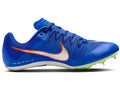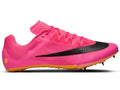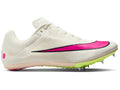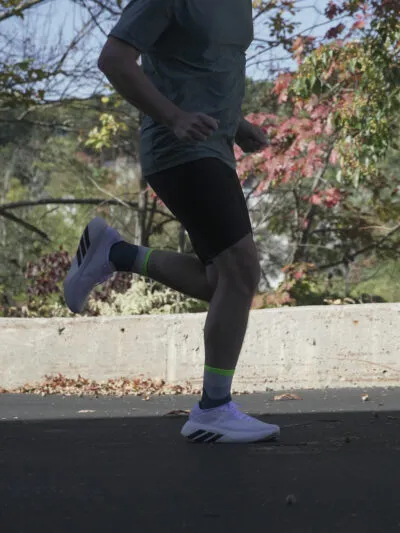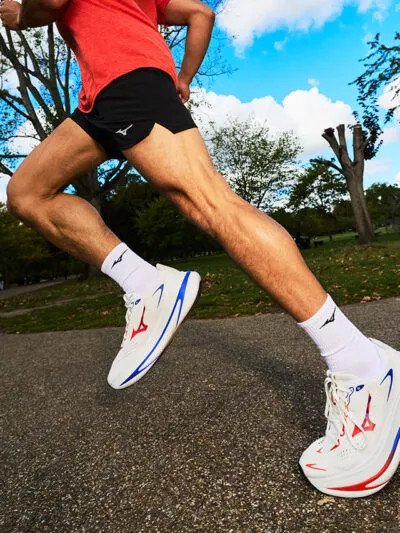
Nike and Brooks are two of the easiest brands to find in any running store. There’s a lot of history with each of these brands. And as it goes with just about any major running shoe brand, they’ve each had their moments of market dominance.
Brooks has long been popular with marathon and everyday runners, while Nike, well, pretty much needs no explanation. But each model in each series is unique unto itself, which is why this comparison pits the two brands against one another based on models for specific uses, rather than the brands as a whole.
We’re going to look at Nike and Brooks to see which has the best:
- Everyday trainers
- Stability trainers
- High-cushion shoes
- Speed shoes
- Race day shoes
Let’s dig in.
Everyday Trainers: Nike Pegasus 42 vs. Brooks Ghost 18
This is the obvious comparison. Two of the biggest names in daily trainers, similar price, similar job, totally different vibe.
The Pegasus 42 is still the GOAT in many ways, as it’s the shoe for runners who want one pair to handle a little bit of everything. The Ghost 18, on the other hand, is its softer, calmer underfoot cousin.
Nike Pegasus 42


The Pegasus 42 is still one of the easiest shoes to slot into a rotation because it’s one of the most well-rounded shoes there are. Runs, gym sessions, walking, treadmill miles, errands, whatever you’ve got. The ReactX midsole and full-length Air Zoom unit give it a more modern feel than your run-of-the-mill foam daily trainer.
There is a little nudge underfoot, and a little more life than older Pegs had, but the wider toebox keeps it from feeling as cramped as it did before.
Nike usually does grip right, and the high-abrasion waffle outsole should hold up over the years, even if you’re doing some trail running. The big limit is distance. It has a sweet spot in the 3-to-8-mile zone, but if you’re stretching into longer runs, it might get a bit uncomfortable
Brooks Ghost 18


The Ghost 18 is yin to Pegasus’s yang. It’s softer, plusher, and wildly stable for a “neutral” shoe. This Brooks shoe features a moderate stack of DNA Loft v3 in the heel and forefoot, with 36 mm in the heel and 26 mm in the forefoot. It also has a wider base than the previous version.
That’s why it feels cushioned and more stable for easy daily mileage, while the updated flex grooves keep it, well, flexible.
The upper is padded in standard Brooks fashion, with an updated flat knit tongue for less pressure around the top of the foot. The catch is that the energy return is pretty underwhelming by our current reviewers’ standards, and the toe box is still a bit tapered unless you buy one of the wider width options.
The Pegasus 42 is still the better all-purpose shoe here. Plain and simple, it’s more versatile. That’s not to say we don’t love the Ghost 18, but we’d only really recommend it trainer vs. trainer for someone looking for a softer, plushy shoe.
Stability Trainers: Nike Structure 26 vs. Brooks Adrenaline GTS 25
Both the Nike Structure 26 and Brooks Adrenaline GTS 25 are big-name stability shoes. However, to us, the Structure feels more like a traditional support shoe with the help built right into the platform, while the Adrenaline takes a lighter-touch approach and trusts its GuideRails setup.
Nike Structure 26


The Structure 26 is a traditionalist’s answer to stability, and honestly, there is something refreshing about a little traditionalism in a running shoe market where everything seems to be more “cutting-edge” than the next.
It has full-length ReactX, a compact and planted platform, a 10.1 mm measured drop, and much stronger heel shock absorption than in the forefoot. All these variables point to the fact that this shoe is built with heel strikers very much in mind.
It also lands in that standard support-shoe lane where. Steady as she goes.
The tradeoff, however, is that at 10.4 oz, with moderate breathability and lower forefoot comfort over distance, it’s not exactly out here trying to charm forefoot strikers or work for long-distance running.
Brooks Adrenaline GTS 25


The Adrenaline GTS 25 doesn’t make as big a show of its support, but it’s there.
The big talking point with Brooks is the GuideRails technology. Instead of aggressively correcting the stride on every step, the raised medial and lateral supports and sidewalls help keep the stride from wandering too far off. This still allows for some natural pronation.
That allowance is probably why this shoe has stayed alive for a quarter century while other stability shoes have come and gone. Brooks also added more DNA Loft v3 this time, bringing the shoe to a 37/27 stack with a 10 mm drop.
The changes have split our reviewers a bit. Some like the extra cushioning and the energy return that comes with it. Others basically compare it to running in Doc Martens (okay, we’re being dramatic, though weight is a factor). At about 10.5 to 10.6 oz, it avoids full cinderblock status and feels lighter than its specs suggest.
For most runners, the Adrenaline GTS 25 is probably the easier stability shoe to live with. The support is there, but it doesn’t feel so constant. We still recommend the Structure 26 for runners who want support to feel obvious.
Max Cushion Shoes – Nike Vomero 18 vs. Brooks Glycerin 23
If you’re in the market for a plush shoe, this is the perfect match-up. Nike went big with the Vomero 18, very much in line with the modern trend of pushing max cushion limits, while the Glycerin 23 is decidedly subtler.
Nike Vomero 18


The Vomero 18 had a bit of a growth spurt. It now sits at 42.5 mm in the heel with ZoomX over ReactX. It weighs 10.5 oz and leans hard into soft landings, particularly for heel strikers.
The heel shock absorption is really solid, and the step-in feel is one of its better traits. It’s a good shoe for easy runs and recovery days, and our reviewers like the fact that it provides protection without any experimental geometry.
The catch with a shoe this comfortable is the baggage it comes with. It’s definitely heavier and less flexible, and not especially eager to move at faster paces.
Brooks Glycerin 23


The Glycerin 23 takes a subtler approach to cloud surfing. It uses Brooks’ nitrogen-infused DNA Tuned setup, with larger cells in the heel for soft landings and smaller cells in the forefoot for a more responsive toe-off.
Yeah, it sounded like marketing to us too, until we realized that the truly useful knowledge is the added 2 mm of foam in the forefoot and the 8 mm heel-to-toe drop. Basically, you end up with a shoe that feels softer and better balanced up front than before.
At 10.6 oz, it is not lightweight either, but still, it feels a bit more relaxed for long runs than its Nike competitor. There’s a wide, supportive platform and full outsole coverage that should wear well.
The downside is that it is still not especially bouncy, and the toebox runs a little narrower than some earlier Glycerins.
For overall comfort, the Glycerin 23 is our winner here. It’s less top-heavy and more content to just cruise. The Vomero 18 has deep Nike-style heel cushioning, which some runners will like. But for most easy miles, we have to give it to Brooks.
Max Cushion Stability Shoes – Brooks Ghost Max 4


Yup, you read that right. Brooks gets to stand on its own here. Nike has plenty of cushioned shoes and a couple of support-minded ones, but if you want both at the same time, meaning a shoe with real stack, a broad base, and some built-in geometry help, Brooks is the only brand with a clear path to success.
The Ghost Max 4 is a max cushion with a high stack at 40 mm in the heel and 36 mm in the forefoot. It has a broad, ultra-stable platform and a GlideRoll Rocker that helps keep the shoe moving.
The upper is Brooks-style plush as well. You really get the whole cozy-slipper feel with the thick tongue and padded collar. It also works well with orthotics, which our reviewers love
The interesting catch is that the “Max” label sells a slightly different fantasy than the shoe offers. It’s stable and comfortable, but heel shock absorption is a little underwhelming for something this big. The ride also favors midfoot and forefoot strikers more than heel strikers, which is worth knowing going in.
Tempo Trainers – Nike Vomero Plus vs. Brooks Hyperion Max 3
This is not a clean apples-to-apples matchup, even though these are both brands’ tempo trainers, and pretending otherwise would be a little silly. The Hyperion Max 3 is much more clearly a purpose-built workout shoe. The Vomero Plus, while faster than your average daily trainer, is also a lot more plush than you’d initially think.
Nike Vomero Plus


The Vomero Plus is for runners who want speed without giving up the soft life. It has a full ZoomX midsole, a 45.6 mm heel, a 35.0 mm forefoot, and a serious amount of kind of shock absorption.
It also has solid bounce, which is why it makes sense for progression runs and longer sessions where something leaner might get uncomfortable.
The problem is that it’s still a lot of shoe. At 10.2 oz, with a stiffer build and a snugger fit, this is not some stripped-down tempo tool. It is a plush trainer that can move when asked.
Brooks Hyperion Max 4
The Hyperion Max 4 makes a much cleaner argument for itself.
With DNA Gold on top, a nylon SpeedVault plate underneath, and RapidRoll-style geometry, not to mention a giant 45/39 stack, it’s less like a basic speed trainer and reaching into super-trainer territory
The shoe has high shock absorption, noticeably better rebound than the older versions, and enough assistance underfoot for long workouts.
At 10.1 oz for men’s and 8.8 oz for women’s, it’s not a featherweight shoe, but it’s also not bulky in a way a shoe this tall can feel.
The Hyperion Max 4 wins for us, mostly because it’s actually built for that job. The Vomero Plus is more for runners who want a faster shoe with a much softer landing.
Race Day Shoes – Nike Vaporfly 4 vs. Brooks Hyperion Elite 5
Race shoes should promise the same thing: free speed, or at least the illusion of it until mile 22.
The Vaporfly 4 is the more popular name here, but the Hyperion Elite 5 is also proof that Brooks is getting more serious about making shoes in the racing category.
Nike Vaporfly 4


The Vaporfly 4 is something of a benchmark for racing, as it’s ultra-light at 5.9 oz, has speedy, Alphafly-inspired geometry, and looks like an instant classic. Nike cut weight pretty aggressively in this version, reworked the upper, and kept the whole thing looking sharp and race-ready without losing the character that made the line such a default pick in the first place.
It’s still quick through the transition and still the shoe a lot of runners will trust first for 5Ks to marathons. Our reviewers love the springy carbon-fiber Flyplate (if you’re looking for a snappy shoe, this is it), and the upper is about as breathable and durable as you can get for something this thin.
The only major downside is that the midfoot and heel are pretty narrow, which limits stability.
Brooks Hyperion Elite 5
The Hyperion Elite 5 is Brooks finally making a race shoe worth comparing to the top dogs.
At 7.2 oz, with a measured 37.6 mm heel, 26.4 mm forefoot, and an 11.2 mm drop, it’s not as light as the Vaporfly, but it’s still very fast.
The big advantage is the foam. Brooks finally got the energy return where it needs to be, and with it, you get a sharp, fast ride with a genuinely plush feel underfoot instead of the usual “fast but harsh” compromise.
It also has strong traction and a breathable, durable knit upper. The weak point, as with the Vaporfly, is stability. The platform is narrow, the outsole durability isn’t that great, and the shoe seems to favor heel strikers more than forefoot strikers.
For most runners, the Vaporfly 4 is still the safer bet because it’s lighter and has more trust behind it. However, the Hyperion Elite 5 is certainly one worth considering if you want to try something new and see how far Brooks has come.
Try on These Nike and Brooks Running Shoes at Marathon Sports
The better pick between Nike running shoes and Brooks running shoes totally depends on feel and preferences.
If you want to sort that out in person, stop by one of the Marathon Sports retail locations and try on the Nike and Brooks models we carry. The Right Fit process can help narrow things down based on your goals, fit, and underfoot preferences.